


Hospitality has always been a difficult industry to staff. Low wages, long working hours, unpredictable schedules, and heavy overall workloads have driven many people away from the industry.
Contrary to popular opinion, the pandemic didn’t create this difficulty, but it accelerated it. A large share of Europe’s hospitality workforce left during that period and never returned, many moving to sectors offering steadier hours and more stability.
Years later, the gap still hasn’t closed: in 2026, according to HOTREC, the European hospitality sector is roughly 10% short of the workforce it needs on average. But staff shortages aren’t the only problem hotels are facing.


Hospitality’s Struggle Is Bigger Than Staff Shortages – It’s Also the Costs
Costs have climbed faster than revenue in most markets, with gross operating profit margins compressing across nearly every hotel segment, even where occupancy has held up. In Germany specifically, 75.2% of hospitality companies name personnel costs as their single strongest cost-pressure factor, according to DEHOGA. Hotels are being squeezed from two directions at once: fewer people willing or available to do the work, and shrinking margin to absorb the cost of finding them.
The staffing shortage and the margin squeeze are really the same problem wearing two different faces – and automation is the one lever that addresses both.
The good news: the same shift making hiring harder – automation moving into the mainstream of hotel operations – is also one of the most impactful levers hotels have to protect and grow profitability. Rather than treating staffing as a hole to keep refilling, hotels are better served treating automation as the answer to both problems at once: the staffing gap and the margin pressure alongside it.
Hotel Automation Has More Benefits Than Solving the Staffing GaP
Automation in hotels isn’t only a response to empty position, it’s a broader operational shift with benefits far beyond staff shortages.
Closing the staffing gap
Automated check-in and check-out, payment, guest communication, and keyless entry take recurring, repeatable tasks off a shrinking team’s plate. Where a missing front desk manager used to mean longer queues, automation fills the gap.
Saving time = saving costs
Beyond guest-facing tasks, automation removes manual admin – syncing data across tools, updating entries, splitting bills, ensuring legally compliant data – enabling hotels to run shifts with fewer people and taking pressure off the team that remains.
Ancillary revenue without lifting a finger
Automated Upselling – early check-in, late check-out, breakfast, parking, spa treatments, and more – captures incremental revenue that an understaffed team often lacks the bandwidth to offer consistently, especially when the lobby is already crowded. It can even refinance the entire cost of the automation software and further ease financial pressure.
Making room for a meaningful guest experience
Automation doesn’t just compensate for being short-staffed – done well, it gives hotels room to exceed the guest experience a fully staffed team delivered, by freeing up time for the personalized, human moments that automation itself can’t replace.
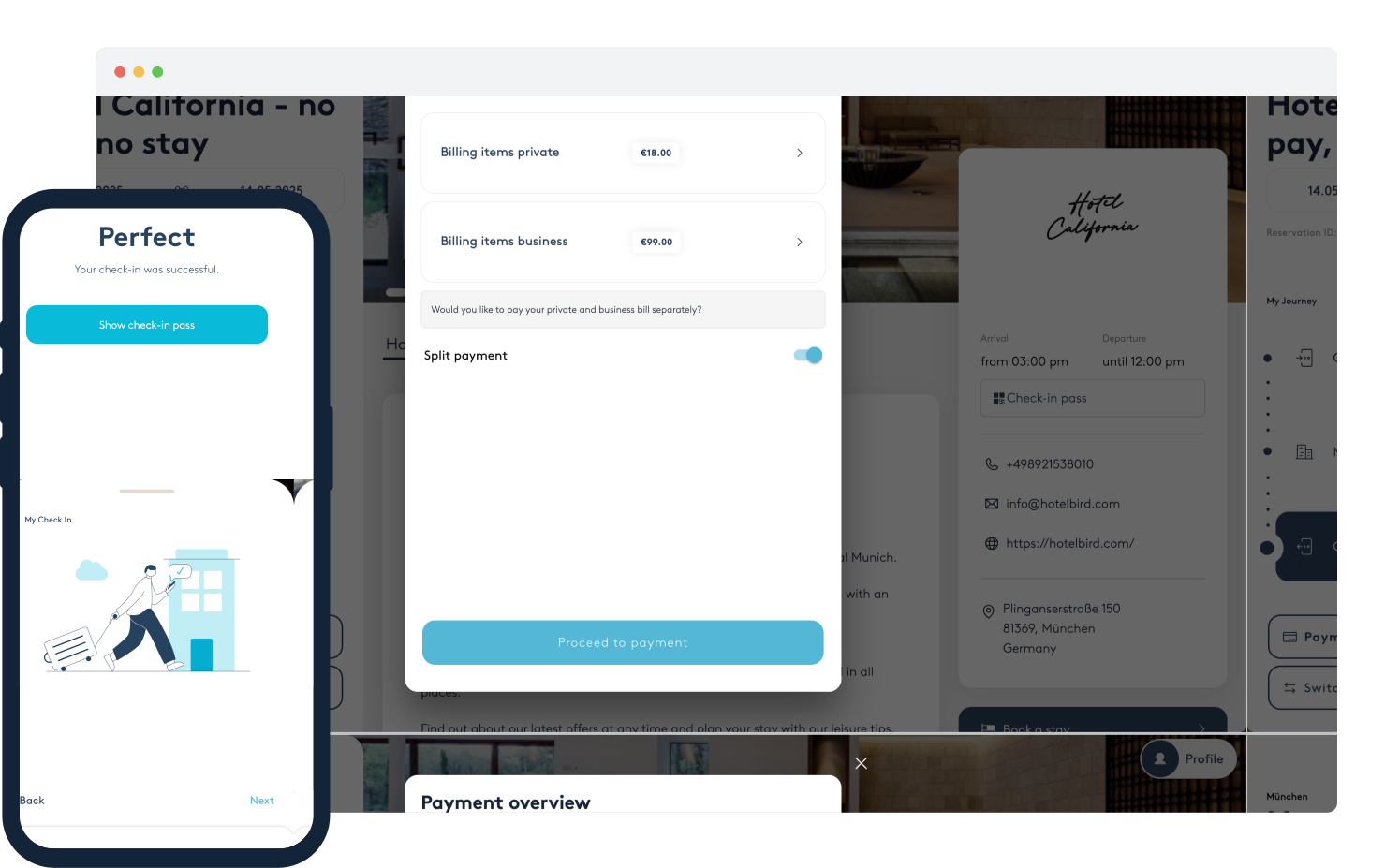
Hotelbird: Die führende Plattform für automatisierte Hotel-Operations
With Hotelbird as the leading platform for automated hotel operations, all of this comes together in one solution. Through deep integrations with best-in-class technology partners across every area needed to automate the guest journey end to end – PMS, payment, access management – Hotelbird connects check-in, payments, communication, room access, and check-out into one seamless journey.
The question for hotels today isn’t how to fill every open role, it’s how much of the underlying problem automation can solve instead.
Hotels close staffing gaps, reduce operational friction and manual workload, and create more room for attentive, high-value guest interaction.
Hotelbird in Numbers
digital check-in and check-out
Automation, Not More Hiring, Is the Way Forward for Hospitality
Hospitality’s staffing shortage has been a long-standing structural condition across the DACH region and Europe more broadly, and it now sits alongside a second, related pressure: shrinking margins that leave hotels less room to absorb the cost of chasing it. Hiring alone can’t realistically fix either.
Automation offers a way out of both at once — closing the operational gap left by vacant roles, protecting margin, and unlocking revenue and guest-experience gains that even a previously fully staffed team wasn’t necessarily capturing. The more useful question for hotels today isn’t how to fill every open role — it’s how much of the underlying problem, staffing, cost, and experience alike, automation can solve.
→ Read more about the Hotel Automation ROI
Häufig gestellte Fragen zur Hotelautomatisierung
What is end-to-end guest journey automation?
Connecting every stage of the guest journey – from pre-arrival to check-out and invoicing – directly to the back office, so the work completes itself instead of landing on staff.
Does hotel automation replace staff, or does it support them?
It supports them. Automation takes over repeatable, transactional tasks – check-in, payment, communication, room access – so existing teams can run leaner without a drop in service, rather than removing the human element from the guest journey.
Can automation actually improve profitability, not just cover staffing gaps?
Yes. Beyond saving labor cost, it opens up ancillary revenue through automated upselling (early check-in, late check-out, spa, parking, breakfast, and more) that understaffed teams often lack the bandwidth to offer consistently – in some cases covering the software cost within the first month.
Does automation hurt the guest experience?
No – done well, it improves it. Removing manual, repetitive tasks from the team frees up time for the guest interactions that actually shape satisfaction and loyalty.
Do guests need to download an app to use Hotelbird?
No. Hotelbird’s digital guest journey is platform-independent and operates entirely through a web-based solution.